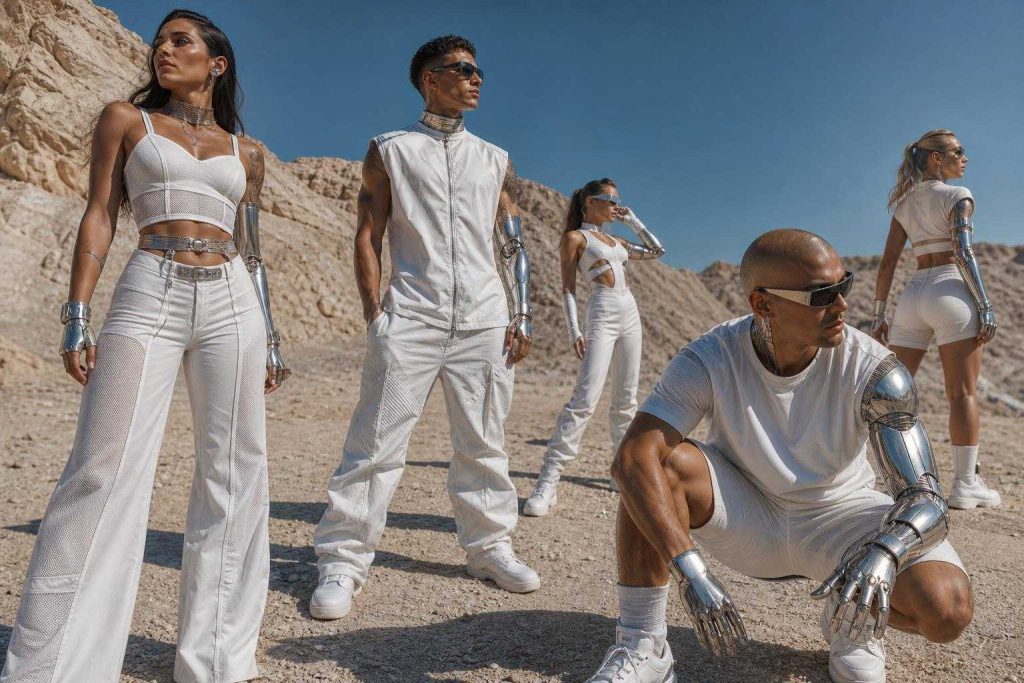
AI Marketing Strategy: What CEOs Should Expect From Their CMO in 2027
Focused keyphrase: AI Marketing Strategy
SEO keywords: CMO in 2027, AI in marketing, future of marketing leadership, CEO expectations for CMOs, marketing transformation, AI-driven growth, Brandlab
By 2027, the relationship between the CEO and the CMO will look radically different. Not because creativity will matter less, but because creativity without intelligence, speed, and operational precision will no longer be enough. The modern chief marketing officer is moving from brand storyteller to growth architect, from campaign overseer to commercial systems leader, and from communications executive to cross-functional transformer powered by AI marketing strategy.
That shift is already underway. Artificial intelligence is changing how brands understand audiences, predict behaviour, personalise experiences, allocate spend, measure performance, and even shape product-market fit. For CEOs, the question is no longer whether AI will affect marketing. It is whether their marketing leadership is prepared to translate AI into measurable business advantage.
This is where boards and leadership teams must become sharper in what they expect. The CMO of tomorrow is not just a communications leader. They are the executive who should connect data, customer insight, commercial forecasting, automation, sales alignment, and brand trust into one growth engine.
So what should CEOs expect from their CMO in 2027? More importantly, what should they demand?
The CMO Role Is Expanding Faster Than Many CEOs Realise
Historically, some CEOs viewed marketing as a cost centre dressed up as strategy. That perception is becoming outdated at speed. In the AI era, marketing is increasingly the function that sees customer demand first, spots shifts earliest, tests messages fastest, and scales learning across the organisation most effectively.
According to McKinsey’s research on the state of AI, organisations using AI are seeing impact in both cost reduction and revenue generation. Meanwhile, Gartner’s marketing insights continue to show that CMOs are under increasing pressure to prove efficiency, accountability, and growth contribution. That combination changes everything.
Marketing is becoming the intelligence layer of the business
The best CMOs in 2027 will not sit downstream from strategy. They will help define it. Why? Because they will have access to real-time customer data, sentiment patterns, search trends, conversion signals, market movements, and predictive insight. That makes marketing a live commercial radar system.
If your CMO can tell you what buyers want before the competition sees the shift, that is not promotion. That is strategic advantage.
Brand and performance will become one discipline
For too long, businesses split brand building and performance marketing into separate camps. AI is helping bring them back together. In 2027, CEOs should expect CMOs to understand not only how to generate demand now, but how to build memory structures, trust signals, creative systems, and customer experiences that drive durable growth later.
Brand without performance is wasteful. Performance without brand is fragile. The next-generation CMO must master both.
What CEOs Should Expect From Their CMO in 2027
1. A clear AI marketing strategy tied directly to growth
It will no longer be enough for a CMO to say the team is “experimenting with AI.” CEOs should expect a documented, prioritised, commercially aligned AI marketing strategy. That strategy should explain:
- Where AI creates immediate efficiency
- Where AI improves customer experience
- Where AI enhances revenue generation
- How AI supports better forecasting and decision-making
- What governance protects quality, privacy, and brand reputation
An AI strategy that only focuses on content generation is too small. A serious strategy spans audience insight, segmentation, personalisation, media buying, testing, CRM, analytics, lead scoring, attribution, forecasting, and workflow automation.
2. Better decisions, not just faster outputs
There is a dangerous temptation in AI conversations to focus on speed alone. Faster campaign production. Faster copywriting. Faster reporting. Faster audience creation. But speed without judgement creates clutter, confusion, and weak positioning.
By 2027, CEOs should expect their CMO to use AI not only to move faster, but to make smarter strategic decisions. That means using machine learning, predictive analytics, and customer intelligence to answer questions such as:
- Which customer segments offer the highest lifetime value?
- Which messages convert best for which audiences?
- Which channels are oversaturated?
- Where is churn likely to rise?
- Which offers should be personalised and when?
The prize is not more activity. The prize is better accuracy in where the business invests time and budget.
3. A marketing function that behaves like a growth lab
In 2027, high-performing CMOs will run marketing teams that look part studio, part science lab, part technology operation. They will constantly test hypotheses, learn from data, refine creative, deploy automation, and turn customer behaviour into action.
This is the future of agile growth. And it matters because markets now move too quickly for annual planning cycles to carry the full weight of decision-making.
CEOs should expect their CMO to have an experimentation framework that answers:
- What are we testing every month?
- What did we learn?
- What did we stop doing?
- What have we scaled?
- What insights are influencing product, pricing, and sales?
If marketing cannot produce that level of commercial learning, it risks becoming busy rather than transformative.
4. Relentless personalisation at scale
Customers increasingly expect relevance. Not generic messaging. Not broad assumptions. Relevance. AI enables a new level of personalisation across email, content, product recommendations, ad creative, website journeys, and service touchpoints.
Research from Salesforce’s State of the Connected Customer consistently highlights rising customer expectations around personalised engagement. Meanwhile, platforms across search, social, and commerce are rewarding relevance with stronger performance outcomes.
By 2027, CEOs should expect their CMO to design customer journeys where AI helps deliver the right message, to the right person, at the right time, for the right commercial outcome.
5. Strong governance, ethics, and brand protection
AI introduces extraordinary opportunity, but it also introduces risk. Hallucinated outputs. Low-quality synthetic content. copyright concerns. Data privacy breaches. Biased targeting. Brand inconsistency. Reputational damage.
A mature CMO in 2027 will not treat governance as an afterthought. They will establish policies, approval systems, human oversight, model usage principles, data standards, and quality control frameworks.
This matters not just from a compliance perspective, but from a trust perspective. In an age of synthetic abundance, trust becomes a premium asset.
The 2027 CMO Scorecard: What Great Looks Like
It helps to move beyond vague ambition and define practical expectations. The following scorecard captures what many CEOs should expect from a strong, future-ready marketing leader.
| Capability | 2027 CEO Expectation | Business Impact |
|---|---|---|
| AI Strategy | A documented roadmap linked to revenue, retention, and efficiency | Smarter investment and faster transformation |
| Data Fluency | Ability to turn customer and market data into action | Better forecasting and sharper decisions |
| Personalisation | Scaled relevance across the customer journey | Higher conversion and loyalty |
| Experimentation | Continuous testing and learning culture | Reduced waste and faster growth loops |
| Governance | Clear AI, brand, and data safeguards | Reduced risk and stronger trust |
| Sales Alignment | Shared metrics, lead intelligence, and funnel accountability | Higher-quality pipeline and revenue visibility |
What Weak CMOs Will Still Be Doing in 2027
Sometimes the future becomes clearer when we identify what will no longer be acceptable. By 2027, underpowered marketing leadership will still be:
- Measuring vanity metrics with little commercial meaning
- Using AI tactically without strategic integration
- Producing high volumes of low-differentiation content
- Operating separately from sales, product, and customer success
- Reporting activity instead of growth impact
- Delaying governance until after risk appears
And here is the blunt truth: CEOs who tolerate that level of marketing leadership will almost certainly watch more adaptive competitors take market share.
Will your CMO lead change, or explain why it did not happen?
That is the question many leadership teams should be asking right now. Because in a market shaped by AI, hesitation has a cost. So does fragmented execution. So does treating marketing transformation as a side project rather than a board-level priority.
Why the Best CEOs Will Push for a New Marketing Contract
The CEO-CMO relationship in 2027 will need a new contract, one based on measurable outcomes, strategic alignment, and shared transformation goals.
The CEO should provide:
- Clarity on growth priorities
- Executive backing for cross-functional change
- Investment in data, tools, talent, and integration
- Realistic expectations on transformation maturity
The CMO should provide:
- A bold but practical AI marketing strategy
- A clear view of where growth will come from
- A disciplined experimentation culture
- Commercial accountability and transparent reporting
- Brand leadership in an era of synthetic content overload
When this contract works, marketing stops being debated and starts being trusted.
Why it matters: That is exactly the kind of leadership CEOs will need from 2027 onward.
AI Marketing Strategy Is Also a Talent Strategy
Technology alone will not create advantage. People will. The best CMOs will build teams that blend analytical capability, strategic thinking, creative excellence, commercial awareness, and technology confidence.
The 2027 marketing team will look different
Expect greater demand for hybrid talent: strategists who understand data, creatives who understand automation, analysts who understand storytelling, and operators who know how to connect systems across the funnel.
According to the World Economic Forum’s Future of Jobs Report, AI and digital transformation are reshaping roles across industries. Marketing will be among the functions most affected because it sits at the intersection of communication, customer insight, technology, and growth.
Great CMOs will redesign work, not just add tools
If AI is layered onto broken processes, the result is simply faster inefficiency. CEOs should expect CMOs to rethink workflows, agency models, operating rhythms, reporting structures, and collaboration patterns. The smartest leaders will ask: what should humans do best, what should machines do best, and how do we combine both for superior outcomes?
The Metrics That Will Matter More by 2027
Dashboard theatre is over. CEOs should expect the CMO to focus on metrics that reveal business movement, not cosmetic activity.
Expect deeper accountability for outcomes
Important metrics may include:
- Customer acquisition efficiency
- Marketing contribution to pipeline and revenue
- Conversion by audience segment
- Retention and lifetime value growth
- Share of search and share of voice
- Speed of experiment-to-scale cycles
- Content productivity and quality efficiency
- Brand trust and sentiment movement
This is not to say creative instinct disappears. It means intuition is supported by evidence, refined by testing, and scaled through systems.
The Strategic Question Every CEO Should Ask Now
If your business had to compete in a market where customer expectations were rising, media efficiency was declining, attention was fragmenting, and AI was accelerating every competitor’s speed, what kind of CMO would you need?
That future is not approaching. It is already here.
So why not get the solution now rather than pay for delay later?
Why let your business drift into 2027 with legacy assumptions, disconnected tools, and unclear executive expectations? Why hope your team discovers a path that stronger strategic leadership could define today? Why leave growth on the table when AI-driven marketing transformation can be designed with intent?
What Is Possible When the Right Strategy Is in Place
It is possible to build a marketing function that sees opportunity earlier. It is possible to make smarter investment decisions. It is possible to create more relevant customer journeys. It is possible to connect brand and revenue. It is possible to scale content without sacrificing quality. It is possible to align sales and marketing with more precision. It is possible to turn AI from noise into advantage.
But possibility only becomes progress when strategy meets execution.
Why Leaders Should Speak With Brandlab
If your leadership team is asking what a credible AI marketing strategy should actually look like, this is the moment to get expert guidance. Brandlab can help CEOs and CMOs cut through hype, identify what matters, and shape a practical strategy that connects technology to growth.
That means asking harder questions, building stronger plans, and creating a marketing function that is fit for 2027 rather than trapped in yesterday’s model.
What could happen if you act now?
You could create a clearer roadmap. You could align leadership around measurable priorities. You could identify capability gaps before they become growth barriers. You could improve efficiency while advancing customer experience. You could build trust while scaling innovation. You could move from AI curiosity to AI advantage.
So ask yourself: if the opportunity is this significant, why not get the solution?
Get in contact with Brandlab to explore how your business can define a sharper, more ambitious, and commercially grounded AI marketing strategy for the years ahead.
Further Reading and Evidence
- McKinsey — The State of AI
- Salesforce — State of the Connected Customer
- World Economic Forum — Future of Jobs Report
- Gartner — Marketing Insights and Research
- Harvard Business Review — Artificial Intelligence
2027 will reward CEOs who expect more from marketing, and CMOs who can deliver more than marketing alone. The businesses that win will not be the ones using the most AI. They will be the ones using it with the most clarity, discipline, and ambition.
https://brandlab.com.au/output1-871-jpeg-3/