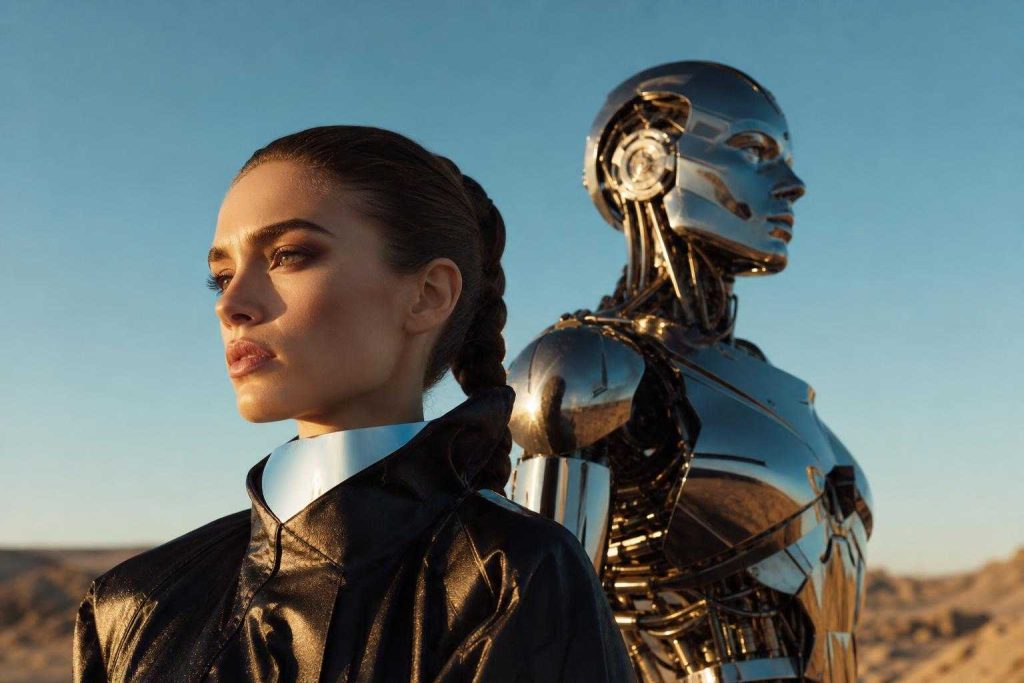
The Biggest AI Marketing Trends Driving Business Growth in 2026
Focused keyphrase: AI marketing trends 2026
Related high-search keywords: AI in marketing, marketing automation, predictive analytics, personalised customer journeys, generative AI for business, AI content creation, AI SEO, customer data platforms, conversational AI, AI-driven growth
There are moments in business when change feels gradual. Then there are moments when it feels like the floor shifts beneath the entire market. 2026 is that kind of moment for marketing.
Artificial intelligence is no longer an interesting experiment tucked away in innovation teams. It is the operating system behind faster campaigns, smarter targeting, better customer insight, leaner teams, and stronger commercial outcomes. Businesses that use AI well are not simply “doing more with less.” They are discovering entirely new ways to create demand, deepen loyalty, and scale growth.
The real question is no longer whether AI belongs in your marketing strategy. It is this: how much growth are you leaving on the table if you wait?
In this article, we explore the biggest AI marketing trends driving business growth in 2026, backed by research, real-world momentum, and practical insight. If you are looking for the signals that matter most, this is where to focus.
Why AI Marketing Matters More in 2026 Than Ever Before
Marketing has always been a balancing act between art and science. What AI changes is the speed, scale, and precision of that balance.
In previous years, teams often had to choose between personalisation and efficiency, between creativity and consistency, between strategic planning and rapid execution. In 2026, AI is erasing many of those trade-offs. It is helping brands create more relevant experiences in less time, while turning vast amounts of customer data into meaningful action.
According to McKinsey’s research on the state of AI, organisations are increasingly integrating AI into core business functions, with marketing and sales among the areas seeing strong impact. Meanwhile, Gartner’s marketing research continues to show that data, automation, and customer experience are reshaping how teams compete.
The shift is commercial, not just technological
This is what makes AI different from many past trends. It is not just another platform to test or tactic to bolt on. It is a commercial growth lever. AI influences how audiences discover brands, how campaigns are built, how budgets are allocated, how content is produced, and how customer relationships are nurtured over time.
And when that happens, marketing stops being viewed as a cost centre and starts being recognised for what it can be: a smarter engine for business growth.
Trend 1: Hyper-Personalisation at Scale Becomes the New Standard
Consumers are no longer surprised by personalisation. They expect it. What changes in 2026 is the level of sophistication brands can achieve through AI.
AI now enables businesses to analyse browsing behaviour, purchase history, engagement signals, intent data, and contextual factors in real time. The result is not just personalised emails with first names. It is dynamic messaging, adaptive website experiences, tailored product recommendations, and individualised customer journeys across the entire funnel.
Why this trend is driving growth
Relevant experiences convert better. Customers are more likely to engage when content feels useful rather than generic. AI helps brands identify what matters to different groups and even different individuals, shortening the path from attention to action.
Salesforce’s State of Marketing research has consistently highlighted rising customer expectations around connected and personalised experiences. That expectation only intensifies in 2026.
“The brands that understand me win my attention. The brands that still send one-size-fits-all messages lose it.”
— Common customer sentiment shaping 2026 marketing strategy
Ask yourself: if your competitors are tailoring every touchpoint with AI, can your business afford to rely on broad, static campaigns?
Trend 2: Generative AI Moves from Experimentation to Production
Generative AI has moved far beyond novelty. In 2026, it is embedded in the day-to-day workflows of ambitious marketing teams.
From blog outlines and ad copy to video scripts, image concepts, landing page variations, product descriptions, and campaign ideation, generative AI for marketing is helping teams produce more without sacrificing strategic quality. The strongest businesses are not using AI to flood channels with average content. They are using it to accelerate good thinking, improve testing velocity, and free up human talent for higher-value work.
The winners use AI with editorial discipline
This matters. Publishing more content is not the goal. Publishing better content, faster, with clearer intent and stronger optimisation is the goal.
IBM’s overview of generative AI explains how generative systems are transforming workflows across industries. In marketing, the practical advantage is obvious: less time spent on repetitive drafting, more time spent on positioning, refinement, and conversion strategy.
What becomes possible
- Rapid multichannel campaign development
- Faster A/B testing of headlines and creative
- Localisation for different markets and audience segments
- Scalable SEO content support
- Sharper brainstorming for campaigns and launches
But here is the real opportunity: AI helps create momentum. And momentum in marketing often becomes market share.
Trend 3: Predictive Analytics Becomes a Growth Weapon
If personalisation is about relevance now, predictive analytics is about seeing what is likely to happen next.
In 2026, businesses are using AI to forecast customer behaviour, identify churn risk, score leads more intelligently, model campaign performance, and uncover hidden opportunities before they become visible to slower-moving competitors.
From reporting the past to shaping the future
Traditional reporting tells you what happened. AI-powered predictive models help you act on what is about to happen. That changes decision-making across paid media, CRM, retention, and sales alignment.
Harvard Business Review’s analytics coverage continues to reinforce an essential truth: companies that turn data into foresight outperform those that only use data for hindsight.
Imagine knowing which customers are showing signals of buying intent, which accounts are drifting, or which campaign combination is most likely to generate pipeline before budget is wasted. That is not marketing theory. That is competitive advantage.
Trend 4: AI-Powered Search and SEO Reinvent Discovery
Search behaviour is changing, and marketers need to change with it. AI-powered search experiences, generative search summaries, and conversational discovery tools are altering how prospects find information and evaluate providers.
This means AI SEO in 2026 is no longer just about rankings. It is about structured authority, semantic relevance, trusted expertise, and content that serves both humans and AI-mediated search environments.
What smart brands are doing now
- Creating deeper topical authority instead of thin keyword pages
- Using AI tools to identify content gaps and optimisation opportunities
- Improving internal linking, schema, and search intent alignment
- Producing expert-led content that earns trust and citations
- Designing content for both search engines and answer engines
Google’s guidance on helpful content is a valuable reference here. The core lesson is clear: useful, reliable, people-first content remains critical, even as AI reshapes search experiences.
The business implication
Discovery is becoming more intelligent. If your brand is not building authority in this new environment, visibility may shrink even while competition accelerates. Why let that happen when the solution is already within reach?
Trend 5: Conversational AI Becomes a Revenue Channel
Chatbots were once treated as support tools of limited usefulness. That era is over. In 2026, conversational AI is becoming a front-line marketing and sales asset.
Modern AI assistants can qualify leads, answer product questions, recommend solutions, book consultations, support onboarding, and guide users through decision-making journeys with increasing sophistication. When done well, they reduce friction and create a sense of immediacy that static websites simply cannot match.
Why this matters to business growth
Speed matters. Buyers want answers now, not after a form disappears into a queue. Conversational AI helps brands capture intent in the moment, keeping prospects engaged when interest is strongest.
Forrester’s customer experience and digital research often underlines the value of reducing friction across customer journeys. Conversational tools do precisely that when aligned with genuine customer needs.
“I don’t want to wait two days for a reply when I’m ready to buy today.”
— A buying behaviour marketers ignore at their peril
Would your business benefit from an always-on digital presence that not only informs but actively converts?
Trend 6: AI-Driven Creative Testing Accelerates Performance
One of the most exciting shifts in 2026 is the rise of AI-assisted creative testing. Rather than relying on instinct alone, marketers can now use AI to generate multiple versions of assets, analyse performance patterns, and refine future creative based on actual response data.
Creative becomes more measurable
This does not diminish creativity. It sharpens it. Great creative has always needed insight. AI provides more of it, faster. Teams can test messaging angles, emotional triggers, formats, hooks, visuals, and calls to action with greater precision.
In paid social, display, email, and landing page optimisation, this creates a flywheel: test, learn, adapt, repeat. Over time, even small performance improvements compound into substantial gains in conversion and ROI.
Trend 7: First-Party Data Strategy Gets Stronger with AI
As privacy expectations rise and third-party data becomes less dependable, businesses are placing greater value on their own customer data ecosystems. AI is helping unlock that value.
A strong first-party data strategy in 2026 is not simply about collecting information. It is about making sense of it. AI helps unify fragmented signals across platforms, spot patterns humans might miss, and turn customer data into sharper segmentation and better timing.
Trust and intelligence now go together
This is one of the most underappreciated growth opportunities in marketing. Brands that handle data responsibly while using it intelligently will outperform brands that either misuse data or fail to use it at all.
Adobe’s customer experience insights frequently highlight the role of trusted, connected experiences. AI makes those experiences easier to deliver when the underlying data strategy is sound.
Trend 8: Marketing Automation Evolves into Intelligent Orchestration
Traditional automation was rule-based. If a customer clicked X, send Y. If they waited seven days, trigger Z. Useful, yes. Intelligent, not always.
In 2026, marketing automation is becoming far more adaptive. AI can optimise send times, recommend next-best actions, personalise nurture flows, score engagement changes, and adjust campaign logic based on live behaviour.
The difference is dramatic
Instead of building rigid systems that need constant manual intervention, marketers can create smarter ecosystems that continuously learn. This improves efficiency, but more importantly, it improves relevance.
| Traditional Automation | AI-Driven Orchestration |
|---|---|
| Fixed rule chains | Adaptive decisioning |
| Broad segments | Micro-segmentation in real time |
| Manual optimisation | Continuous AI-led refinement |
| Delayed insights | Near real-time performance intelligence |
If your current automation feels clunky, outdated, or underperforming, why not get the solution that aligns technology with commercial ambition?
Trend 9: AI Helps Smaller Teams Perform Like Bigger Ones
Not every business has a huge in-house marketing department. That used to be a major disadvantage. AI is changing that equation.
With the right systems, smaller teams can accelerate research, streamline production, improve reporting, scale campaign variants, and maintain consistency across channels. This democratisation of capability is one of the most powerful aspects of AI-driven marketing.
Efficiency is not the end goal
The deeper value lies in confidence. Teams can act faster because they are supported by better intelligence and better tools. Leaders can make decisions with clearer visibility. Businesses can punch above their weight.
Trend 10: Human Strategy Becomes More Valuable, Not Less
Here is the most important trend of all: as AI becomes more accessible, strategy becomes the defining differentiator.
Anyone can access tools. Not everyone knows how to align them with brand positioning, customer psychology, commercial goals, and measurable outcomes. The businesses seeing the strongest returns are those that pair AI capability with clarity of purpose.
Technology without direction creates noise
AI can generate content, automate journeys, and surface insights. But it cannot replace the deeper judgment needed to define category position, emotional resonance, competitive advantage, and long-term growth direction. That still requires people who understand markets, brands, and human decision-making.
That is why many companies are asking a bigger question now: not “Which AI tool should we try?” but “How do we build a smarter growth system?”
What This Means for Your Business in 2026
If these trends feel significant, that is because they are. But they are not abstract predictions. They are practical signals about where the market is going and how customer expectations are evolving.
The businesses that move now can:
- Create more effective campaigns in less time
- Improve lead generation and conversion rates
- Strengthen retention through better personalisation
- Reduce wasted media spend with predictive insight
- Build stronger visibility in AI-shaped search environments
- Enable teams to work faster and smarter
- Unlock new levels of sustainable growth
And the businesses that delay? They risk becoming less visible, less relevant, and less efficient while competitors create momentum that is harder to catch.
Why Brandlab Is the Right Conversation to Have Now
This is where strategy matters. AI is full of promise, but promise alone does not drive growth. Execution does. Integration does. Intelligent planning does.
If your business wants to make sense of the biggest AI marketing trends 2026, identify the opportunities with the strongest commercial upside, and build a practical roadmap that delivers results, it makes sense to speak with Brandlab.
What Brandlab can help you explore
- AI-led content and campaign strategy
- Smarter personalisation and automation journeys
- SEO and content visibility for evolving search behaviour
- Conversion-focused customer experiences
- Data-informed growth planning
- Marketing systems designed for measurable business impact
The AI era is not waiting. Your competitors are testing, learning, refining, and moving. Why not get the solution? If you want a marketing approach built for 2026 rather than one stuck in the assumptions of the past, get in contact with Brandlab and start the conversation.
Final Thought: The Future Belongs to Businesses That Act
The biggest AI marketing trends driving business growth in 2026 all point to one truth: smarter marketing is now a choice. The tools exist. The research is clear. The opportunity is real.
What separates leaders from laggards is not awareness. It is action.
Will your business use AI to personalise more deeply, predict more accurately, create more effectively, and grow more confidently? Or will you let uncertainty slow progress while others move ahead?
The brands that win in 2026 will not be the ones that simply talk about AI. They will be the ones that use it with intention, imagination, and commercial focus.
That future is available now. So ask yourself the question your market will answer soon enough: why not get the solution?
Contact Brandlab to explore what AI-driven marketing growth could look like for your business.
167478